
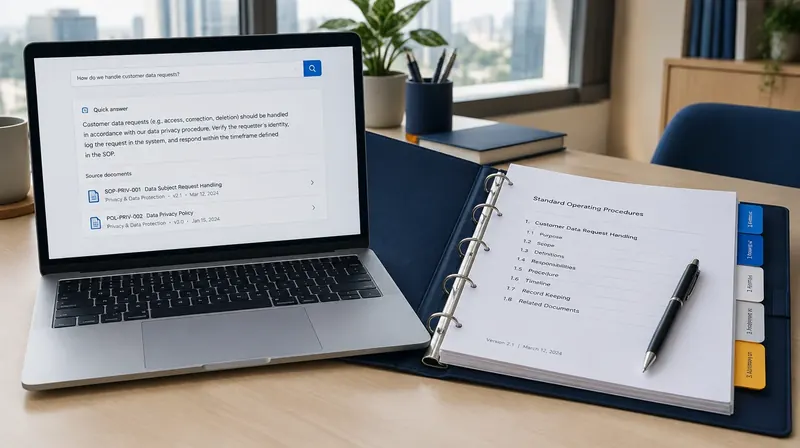
What is RAG?
Retrieval-Augmented Generation, or RAG, retrieves relevant information from documents before an AI model drafts an answer. For businesses, this can help teams find procedures, policies, or manuals through everyday questions. References let users check the source.
What problem can it help solve?
When documents are scattered and versions change, manual search takes time and can produce inconsistent answers. KODE maps authoritative sources, prepares a search index, and designs knowledge assistants for authorized teams. Start with one document collection with clear ownership and scope.
Document readiness determines quality
Review formats, readability, versions, structure, and ownership. Scanned documents may need OCR and additional checks. Define metadata, update schedules, and handling for withdrawn documents. RAG does not automatically fix contradictory or outdated sources.
Permissions and answers without evidence
Retrieval must respect the user’s permissions for source documents. Agree identity, storage, model-provider, and logging requirements. The assistant should acknowledge missing information, show references, and escalate to the process owner when needed. RAG does not guarantee every answer is correct.
Pilot evaluation and cost
Prepare tests covering direct answers, multiple documents, old versions, and questions that should not be answered. Assess accuracy, reference quality, and search time. Document count and formats, update frequency, access controls, and usage volume inform the cost estimate.
Deliverables discussed during scoping
- Source inventory, metadata, and update rules
- Document retrieval and answers with references
- Test scenarios and access-control and operations documentation
Common questions
Do we need to train our own AI model?
Not always. RAG retrieves context from selected sources. Model choice and customization depend on quality, data, cost, and project constraints.
Can it use PDFs and internal procedures?
We can assess feasibility after reviewing format and text quality. Confidential files are not needed for the first discussion; an overview of volume, types, and access structure is sufficient.